By it’s very nature, weather is dynamic and constantly changing. Weather is a phenomena in which the atmosphere and all its components have been trying from the beginning of time to reach a state of equilibrium.
The current weather conditions along with reasonably predicted expectations of weather should be a prime consideration for anyone venturing out onto the water in any type of vessel.
Here are some things you should “KNOW….before you GO!”
- The direction from which most storms eminate in your area. Then keep a closer eye in that direction while you’re on the water.
- How to make a rough forecast using basic principles of wind direction, atmospheric pressure, and temperature changes.
- Cloud formations and what they mean.
- Where to find up-to-date weather information on your AM-FM , VHF, or SSB radio.
- How to determine the center of a low pressure system just by facing the wind using Buys Ballots Law.
- The location and approximate time it will take you to get to an accessible safe harbor.
- How to use a drogue or storm anchor, or things that could be used as a makeshift substitute.
- The meanings and locations of shore-based storm signals in your area.
- The importance of wearing life jackets if you get caught out in poor conditions.
SOME FACTS AND TIPS ABOUT LIGHTNING
(Some of the following is adapted from NOAA’s Factsheet Vol. 1, May 16, 2001: ‘Lightning Safety for Mariners’, and from an article on the subject by Mike Kuntz, Park Ranger at Lake Barkley, KY)
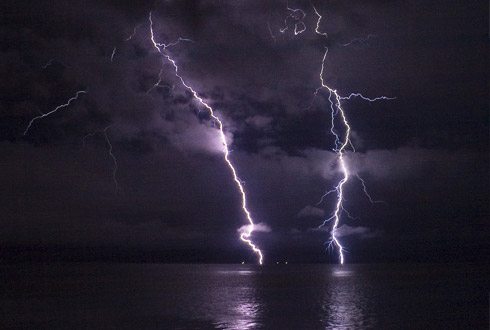
Summer is the peak season for one of the nation’s deadliest weather phenomena – lightning. An average of 73 people in the U.S. are killed each year by lightning. (In 2003, there were 44 deaths.) That’s more than the annual number of people killed by tornadoes or hurricanes. Many more are struck but survive. Those who do survive often report a variety of long-term, debilitating symptoms, including memory loss, attention deficits, sleep disorders, numbness, dizziness, stiffness in joints, irritability, fatigue, weakness, muscle spasms, depression, and an inability to sit for long.
Safeguarding U.S. residents from dangerous lightning is the goal of the National Weather Service’s (NWS’s) Lightning Safety Website. The site is part of a campaign to lower lightning death and injury rates and America’s vulnerability to one of nature’s deadliest hazards.
Some suggested boating lightning safety tips:
- Check the weather before you go out on the water (know before you go).
- Carry a VHF-FM radio, or at minimum an AM-FM radio or NOAA weather radio, and regularly tune in to weather and/or marine broadcasts.
- Steps to take if you can’t get off the water.
- Make sure friends and family know where you planned to go and when you planned to return (have a float plan).
- An unconscious boater has NO chance on the water; ALWAYS wear your life jacket!
Folks that work on or near the water may also want to consider storm spotter training. This is a 2-3 hour class put on by your local National Weather Service Office. Find your local NWS office by visiting the National Weather Service web site.
Mariners are particularly at risk for lightning strikes. Marine vessels are often the tallest objects in a large open space. Seeking the tallest objects, lightning has blown out the bottom of boats and caused millions of dollars in damage to navigational equipment. The glow on a masthead produced by an extreme buildup of electrical charge is known as St. Elmo’s Fire. Unprotected mariners should immediately move to shelter when this phenomenon occurs. Lightning may strike the mast within five minutes after it begins to glow.
You can tell how close you are to a lightning strike by counting the seconds between seeing the flash and hearing the thunder. For every five seconds you count, the lightning is one mile away. If you see a flash and instantly hear the thunder, the lightning strike is very close. Take shelter immediately. A hand-held bearing compass can be used to determine if you are in the path of a storm. By observing the storm’s ground flashes and using a series of bearings, you can plot the approach of a thunderstorm. If the bearing of the flashes doesn’t change, the average storm is heading toward you, and it is time to alter your course.
Lightning is a threat whenever:
- You see lightning or hear thunder
- You hear loud static on your AM radio
- You hear buzzing sounds on radio antennas
- Mastheads begin to glow
The principle lightning safety guide is the 30-30 Rule. The first ’30’ represents 30 seconds. If the time between when you see the flash and hear the thunder is 30 seconds or less, the lightning is close enough to hit you. If you haven’t already, seek shelter immediately. The second ’30’ stands for 30 minutes. After the last flash of lightning, wait 30 minutes before leaving your shelter. More than one half of lightning deaths occur after a thunderstorm has passed.
Before you get out on the water, know what conditions to expect. Listen to a NOAA Weather Radio for weather info and plan your trip accordingly. If severe weather is approaching or forecast, the best bet is to stay ashore. Even when conditions look good, mariners should still leave a float plan with a marina or someone ashore, and make sure they have an escape route planned in case a thunderstorm cuts off the original course back to land.
Continue to listen to weather forecasts; conditions can change dramatically out on the water. At the FIRST sign of severe weather approaching, GET OFF THE WATER, GET OUT OF YOUR VESSEL, AND SEEK SHELTER IMMEDIATELY INSIDE A STURDY BUILDING OR VEHICLE. If a thunderstorm catches you unexpectedly and you CANNOT get to shore immediately, follow these safety guides:
- Keep away from metal objects not grounded to the vessel’s protection system. Contact with them during a direct hit can cause electrocution. Position yourself in the middle of the boat and get as low to the deck as possible.
- Stay out of the shower and away from other plumbing fixtures. The electrical charge often travels along and through plumbing.
- Wear a life jacket at all times. A victim struck by lightning can be rendered unconscious and fall overboard.
- Stay tuned to NOAA Weather Radio for the latest warnings, watches, advisories, and forecasts from the local National Weather Service office.
REMEMBER! THE ONLY PREDICTABLE CHARACTERISTIC OF LIGHTNING IS ITS UNPREDICTABILITY!
Visit these sites for weather maps, forecasts, and current conditions for your locale and around the world!
- Weather Underground – Marine Forecast
- Pacific Tsunami Warning Center
- NOAA Marine Forecasts
- NOAA Home Page
- The National Weather Service
- The Weather Channel
- USA Today Weather Page
- National Data Buoy Center
- National Weather Bureau Interactive Weather
- Storm Prediction Center, Norman, OK
- National Hurricane Center
- Wind and Wave Conditions/Forecasts – Great Lakes
- AccuWeather