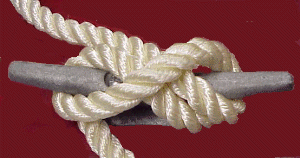
The nautical term Marlinespike comes from the name given to a sharply pointed, iron pin that is used to splice line. The word is also used today to describe knots and bends used in nautical applications. Every boater should know basic Marlinespike, including the reef or square knot, the clove hitch, the bowline (pronounced bo-lun), the cleat hitch, the sheet or becket bend, and other basic knots and bends. It’s not necessary for the recreational boater to know how to tie a bowline with one hand, or to splice a line, or to weave a monkeyfist. But basic knowledge of Marlinespike will make your job of skipper, mate, or deckhand easier, and you’ll look like a skilled boater on the water and at the dock.
In commenting about his “love of rope” as a boy and into manhood, Lt/C Barry Briggs, S, of the Durham (NC) Power Squadron wrote this ditty, which was published in the August 1999 edition of the National Power Squadron magazine, Ensign. With permission of its author, I give you…
Ode to Rope
As I cast off for that very first time,
The “rope” in my hand has now become “line”.
And hauling the sails to the top of the mast,
That “rope”, now a “halyard” holds strong, taught and fast.
Then sailing in brisk winds full force on a beat.
The sails are trimmed in by that “rope” that’s a “sheet”.
And now at my anchorage with sails safely stowed,
I trust in that “rope” that now serves as a “rode”.
Through all my life I will never lose hope,
Of a reason or time to play with a rope.
Four Basic Knots You Should Know:
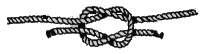
The Square or Reef Knot

The Sheet Bend
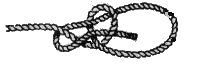
The Bowline
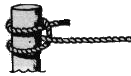
The Clove Hitch
If you master these four knots, you’ll be way ahead of most recreational boaters in your knowledge of marlinespike.
A “Bit” About Lines….
There are many materials used today to make line (ropes are on shore, line is afloat). The most popular is nylon. It is strong, holds up well to the weather and stress, and coils nicely without too much kinking. Line is also made from natural fibers like cotton and hemp (manila), and other synthetic fibers such as dacron, kevlar, spectra, technora, and polypropylene. Nylon three strand is the preferred line for docklines, since it stretches sufficiently to dampen the sharp shocks of wave action and wind against your cleats. Dacron doesn’t stretch as much, and is used for sailboat running rigging and other applications where you don’t want stretch to interfere with your sets. The big advantage of polypropylene line is that it floats. Therefore, it is appropriate for ski lines or other applications where you want to be able to see the line on top of the water.
Line is constructed in two basic ways, although there are variations on the theme. The first is “3 strand” line.

Three strand twisted line can be “laid” right or left, and should always be coiled with the lay of the line. If you hold a length of 3 strand right-hand laid twisted line at arm’s length and eyeball it, you will see the wrap of the line twisting to the right.
The other construction type is braided line.

Braided line can be single or double braided, and in both cases the line is braided around a central core. This type of line does not stretch to the degree that twisted line does, and is more difficult to splice. However, it goes through a pulley or block very well because of it’s rounded shape, and is stronger than its equivalent size twisted line.
Whichever lines you choose to use, make sure they are kept out of the sun when not in use, clean, unfrayed, and coiled neatly. Don’t leave knots in a stowed line for long periods of time. Protect the line from chaffing. And unlike the American flag, which you may have learned from childhood is to be flown until it is too worn or soiled to be displayed, boat lines need to be replaced at the first sign of wear.
Dock Lines for your Boat
There are really two kinds of dock lines…those you leave on your dock at your home slip to secure your vessel when you “put baby to bed”, and those that you take with you for mooring as a transient at somebody else’s slip, like a public landing, a marina or marine basin, the yacht club, or a friend’s boat. We’ll talk here about the lines you take with you, as opposed to the lines you leave at home.
You should carry at least six lines with you at all times for safely mooring your boat. Two bow lines, two stern lines, and two spring lines. Each line should be 10% longer than your boat, so if your boat is 20 feet long, your lines should be at least 22 feet in length, measured from the eye to the bitter end. If you think that’s not possible, then at least make sure that two of them are that long…the ones you intend to use as spring lines. (Of course, there is an advantage to having all six lines the same length…you won’t have to try and sort them out when needed to find the right length line.)
When selecting the size line for your dock lines, consider the size of your boat and the size of your cleats. Cleats should measure one inch in length (tip to tip) for each 1/16 inch of line diameter. So, if you want to use a 1/2 inch diameter line, your cleats should be at least 8 inches long. Here’s a chart with suggested line sizes by boat size, published by West Marine.
| Boat Length | 0-27′ | 28-36′ | 37-45′ | 46-54′ |
| Line Diameter | 3/8″ | 7/16″ | 1/2″ | 5/8″ |
For purposes of transient docking, nylon line is generally preferred material. Nylon line is generally constructed in three-strand twisted, or braided. Three-strand is less expensive, size for size has more stretch (a desirable characteristic to absorb the shock of wave action on the cleats), but is rougher on the hands. Braided line, conversely, has a tendency to “snag” more easily of rough surfaces, and therefore generally has a shorter life when used as dock lines.
Each transient line should have an eye spice on one end. The eye should be large enough to slip easily over the size piling you expect to encounter. If you’re going to do the splicing yourself, you’ll need to practice a bit, and may find that splicing stranded line is a lot easier than double-braided.
Here are some great sites to visit to learn more:
Useful Outdoor Knots – Idaho State University (Suggested by Edward from Tucson – pay close attention to the “Driver’s” or “Trucker’s Knot – very useful)
Breaking the Code: A Complete Guide to Knots (Suggested by student Tyler Morgan of New York)
Animated Knots by Grog
Netknots.com…good illustrations
Manitou Boats – Knots on Video
Boatsafe Marlinespike-Introduction
Amazon – Encyclopedia of Knots and Fancy Rope Work