The U.S. Coast Guard is finally moving forward with its long-awaited plans to scrap its antiquated coastal communications and distress system and replace it with $600 million worth of state-of-the-art technology.
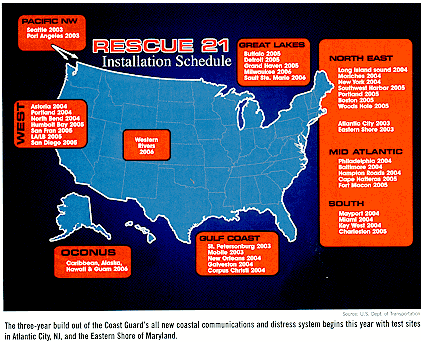
With its coastal 911 system on the drawing boards for over a decade, an installation schedule was recently released by the Dept. of Transportation and has been reproduced below so boaters can see for themselves what Coast Guard stations will be upgraded and when.
Even though six areas are set to have upgrades completed this year as guinea pigs to field-test the system, the U.S. will not be declared fully operational until the entire installation is completed nationwide in 2006. Until then, the Coast Guard will not be officially monitoring Channel 70, the frequency for digital selection calling (DSC). Boaters should continue to rely on Channel 16 for all distress calls.
Another major improvement is the switch from an unpronounceable acronym for the system (NDRSMP) to the very descriptive name, Rescue 21. In September, General Dynamics was named the winning contractor for the $611 million job. Rescue 21 will cover all continental U.S. coastlines up to 20 miles from shore, the Great Lakes and Western rivers as well as Puerto Rico, Hawaii, Guam and Alaska.
Annually, the Coast Guard conducts 40,000 search and rescue cases and saves 4,000 lives. But using a system designed in the 1970s, it has been hampered by coverage gaps in the VHF-FM radio system, lack of direction-finding in many areas and other shortfalls. Rescue 21 is designed to take the search out of search and rescue as it will include:
Automatic identification of incoming calls using DSC radios;
Automatic location of vessels in distress via DSC and GPS;
Eliminating all gaps in VHF coverage;
Immediate direction finding with DF playback capabilities;
Instant playback of radio calls.
As a member of the Coast Guards Global Maritime Distress and Safety System (GMDSS) Implementation Task Force, representing the recreational boat sector, BoatU.S. keeps abreast of all Rescue 21 developments.
When Rescue 21 is in place, all boaters should benefit from the improved communications to and from the Coast Guard on 95,000 miles of coastline. But those who have upgraded to VHF radios with the DSC feature will be ready to take full advantage of the new technology, should they need it in an emergency.
A DSC-equipped radio has a mayday button on it that will automatically send a mayday on Channel 70 with the vessels identification, and, if the radio is connected to an on-board GPS receiver, it will also automatically transmit the vessels coordinates. The mayday will continue to be broadcast even if the skipper is incapacitated, until the call is answered.
In order to be identified, a DSC radio owner needs to obtain an official ID number called a Maritime Mobile Service Identity (MMSI). The number is programmed into the radio and identifies the caller, which should eventually cut down on hoax distress calls. The radios owner, his vessel description and emergency contacts are also entered into a national SAR database kept by the Coast Guard.
BoatU.S. was the first organization granted authority to register DSC radios and issue MMSI numbers to recreational boaters. The service is offered for free by BoatU.S. so that boaters can avoid having to pay the FCC a $150 fee for a license. (Those with a FCC license, however, already have a MMSI, and should not register with BoatU.S. The Coast Guards database managers would like to avoid duplicate registrations.)
For more information, go to BoatUS.com/mmsi and view Frequently Asked Questions.